crescendo
Crescendo Pilot — What We Ran
Frank & Erin · May 2026 · Pre-read for the program overview meeting
Summary
Crescendo Pilot is a practitioner program for Lyric customers. The pilot ran four weeks in April and early May 2026, with six live sessions, three builds, and an in-person Finale in Chicago on May 7. 18 supply chain practitioners from Lyric customer accounts took part. Eighteen prototypes were shown at the Finale.
What this memo covers. What Crescendo is, how we ran the pilot, what students built, and what they walked away with. What this memo does not cover: what we’d change for Crescendo 1 in September. Those decisions live in the separate Crescendo 1 decisions memo.
What Crescendo is not. Crescendo is a prototyping program. It does not cover building science notes, training ML models, or authoring forecasting logic. Graduates wire existing Lyric capabilities into apps that earn the room.
The thesis
Crescendo exists to help supply chain practitioners become heroes inside their own companies. That’s the orienting goal of every session, every assignment, and every framework. The students who finish the program leave with the breadth, the craft, and the prototype to walk into a leadership room with work that earns it — work that builds their reputation, accelerates their career, and changes how their organization sees what’s possible.
To get there, the program tackles two problems most practitioners share:
The breadth problem. Most practitioners are deep in one domain — strategic sourcing, or inventory, or transportation, or demand forecasting — and shallow in the others. But the work has changed. Decisions now cut across domains: a sourcing call is a transportation call is an inventory call is a forecast call. Practitioners need analytical breadth across the full supply chain surface area, not just depth in their specialty.
The delivery problem. Even where practitioners are analytically strong, most struggle to walk a leadership room through why the analysis matters and what to do about it. The work is right; the room doesn’t feel it.
Crescendo’s offer to practitioners: breadth across the decision mesh, deep hands-on Lyric work, the storytelling craft to deliver it, and a peer network across the industry. By the end you have a working Lyric Studio prototype, a story you can tell about it, and a clearer sense of the role you can play in your company’s future.
The offer to Lyric: we deepen relationships with practitioner-level users at customer accounts, turn those practitioners into advocates and internal champions, and produce a stream of compelling customer-built artifacts.
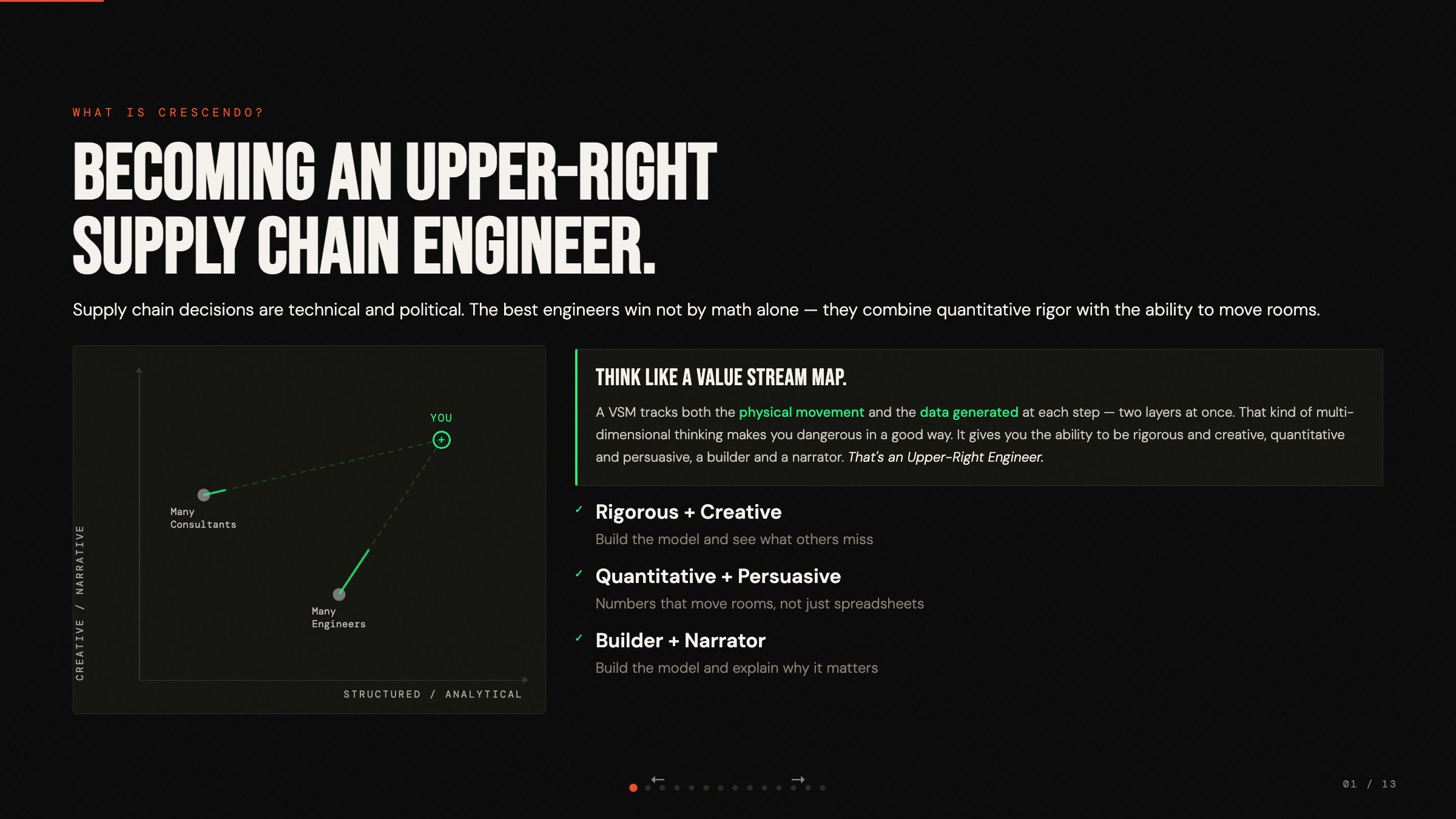
Session 1’s framing of the program’s North Star: the upper-right engineer combines quantitative rigor with the ability to move rooms.
The structure
Four weeks, three builds, one stage.
| Week | Theme | What got built |
|---|---|---|
| W1 | Decisions | Decision Mesh — pick a decision, build synthetic inputs, run a Lyric science note |
| W2 | Analysis | Persona-driven Lyric Studio app wrapping the science note |
| W3 | Narrative | A 5–10 minute story pitched live in Chicago |
| W4 | Chicago | The Finale — every student presents, one wins Best Storyteller |
Six live sessions across the four weeks (Sessions 1 and 2 in W1, 3 and 4 in W2, 5 and 6 in W3), plus the Finale in W4. Each week followed the same rhythm: live teaching session → assignment posted → first draft → peer review → final.
Breakout rooms ran inside every live session — small groups with a single prompt and a tight timer. The format varied: solo working sessions, pair-programming, group debates. Below is the Session 4 Pair & Build breakout — one student drives, the other pair-programs, swap at the halfway mark.
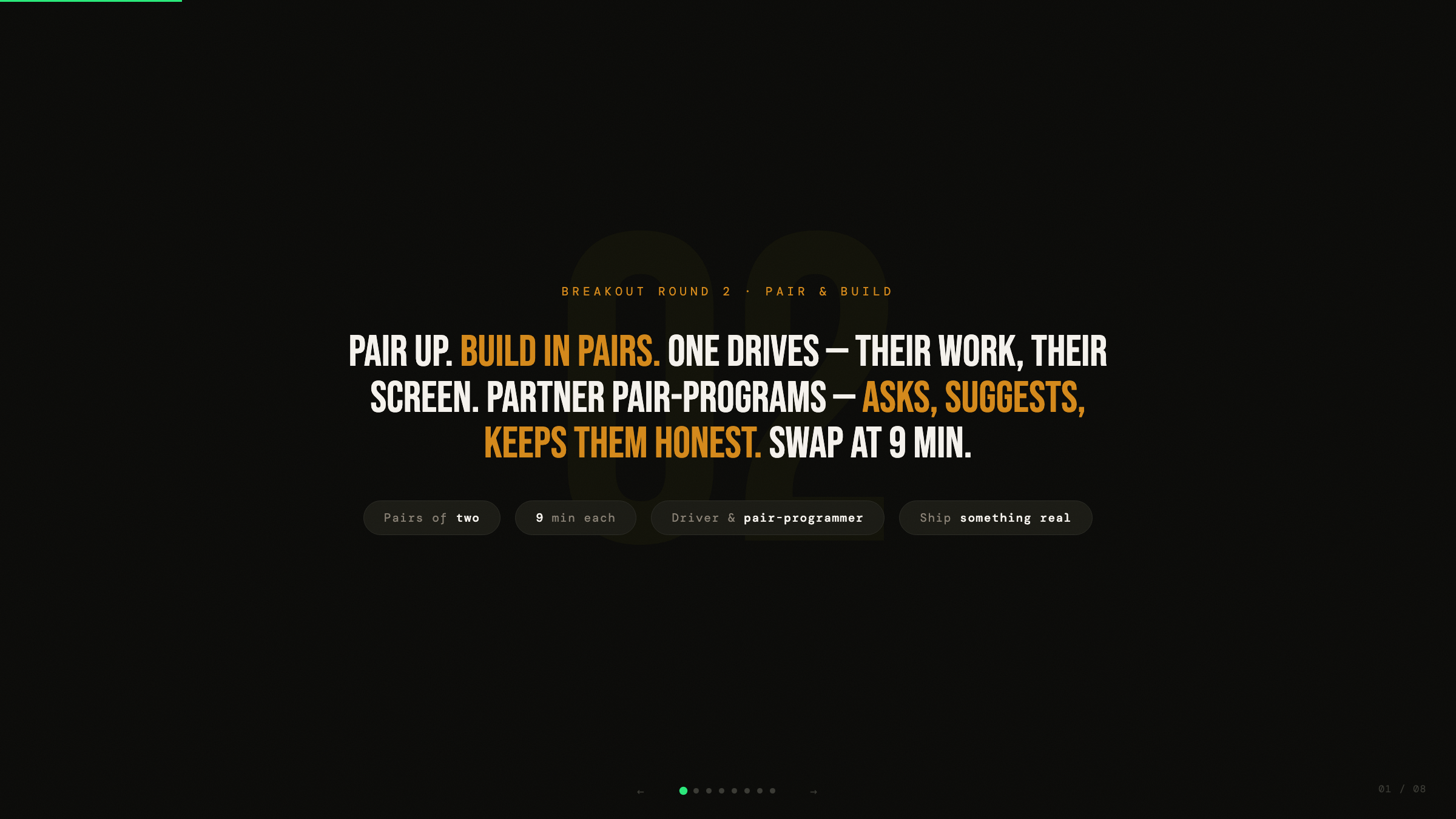
Session 4’s “Pair & Build” breakout. One drives. The partner pair-programs — asks, suggests, keeps them honest. Swap at 9 min. Average breakout rating across the pilot: 4.2 / 5.
We charged customers $0 for the pilot. Customers paid travel and lodging for the Finale.
The cohort
18 students drawn from Lyric customer accounts. Roles ranged from senior managers of supply chain optimization to planning analysts. Companies represented include Coca-Cola Consolidated, Suntory Global Spirits, Beyond Better Foods, Niagara Bottling, and Bob Evans Foods, among others.
Frank Corrigan and Erin Watson facilitated every session, designed the curriculum, and ran the operations end to end. Vicki Richmond organized the celebratory dinner. Graham and Jake — with help from Marco — handled Finale lunch logistics. Jessie Esteban connected us with the videographer who captured the Chicago Finale on video.
What we taught — the three builds
Build 1 · Decision Mesh. The decision mesh presents 12 supply chain decisions across four domains (Network, Inventory, Transportation, Planning) and three planning horizons (Strategic, Tactical, Operational). For each decision, students picked a node, generated synthetic input data for the required Lyric input tables using Lyric’s Studio AI Agent, ran the corresponding Lyric science note (“Blue Note”), and explained why each input mattered.
Build 2 · Persona-driven app. Students wrapped their science note in a working product for one of three persona archetypes:
- Execution Eric — daily/weekly, alert-driven
- Tactical Tina — monthly/quarterly, auto-scenario-driven
- Strategic Stan — quarterly/yearly, exploration-driven
The product had to be designed against Lenny Rachitsky’s five product principles (see frameworks below) and had to be a product, not a dashboard — students had to be able to explain what action their user would take. Build path was Lyric’s Next Gen Apps.
Build 3 · The narrative + the trailer. Students took two weeks of work — their decision, their data, their app — and turned it into a five-to-ten-minute narrative they would deliver live in Chicago the following week. They picked one of seven story types (see frameworks), shaped the arc, and recorded a two-minute trailer video that served as the deliverable for the week. The trailer was the contraction exercise made real: if you can’t say it in two minutes on camera, you don’t know your story yet. The full 5–10 minute version was then performed live at the Finale, where one student won Best Storyteller, Crescendo Pilot Cohort.
What we taught — the named frameworks
The program is organized around nine named, reusable frameworks — plus SPEC as the tenth, used for peer feedback across every build. Students who finished the pilot can name them, explain them, and point at where they used them in their work.
The nine, in the order students encountered them:
- Upper-Right Engineer (Session 1). Quantitative + Persuasive. The North Star — what a Crescendo graduate looks like.
- AI Is an Umbrella Term (Session 1). Statistics, ML, optimization, LLMs — all “AI.” Practitioners need to know what the umbrella actually covers and which tool to reach for when.
- The Decision Mesh (Session 1, applied in Build 1). How supply chain decisions actually flow across functions, horizons, and systems. The framing that makes the whole program coherent.
- Supply Chain Personas (Session 3, applied in Build 2). Strategic Stan · Tactical Tina · Execution Eric. Each has a defined time horizon, rhythm, and app pattern. Students picked one and built for them specifically.
- Lenny’s 5 Product Principles (Session 3, applied in Build 2). Source: Lenny Rachitsky.
- Love the problem.
- Build for someone you can name.
- Cut scope — specify what you won’t include.
- Make the first 30 seconds magical.
- Design for a decision, not a report.
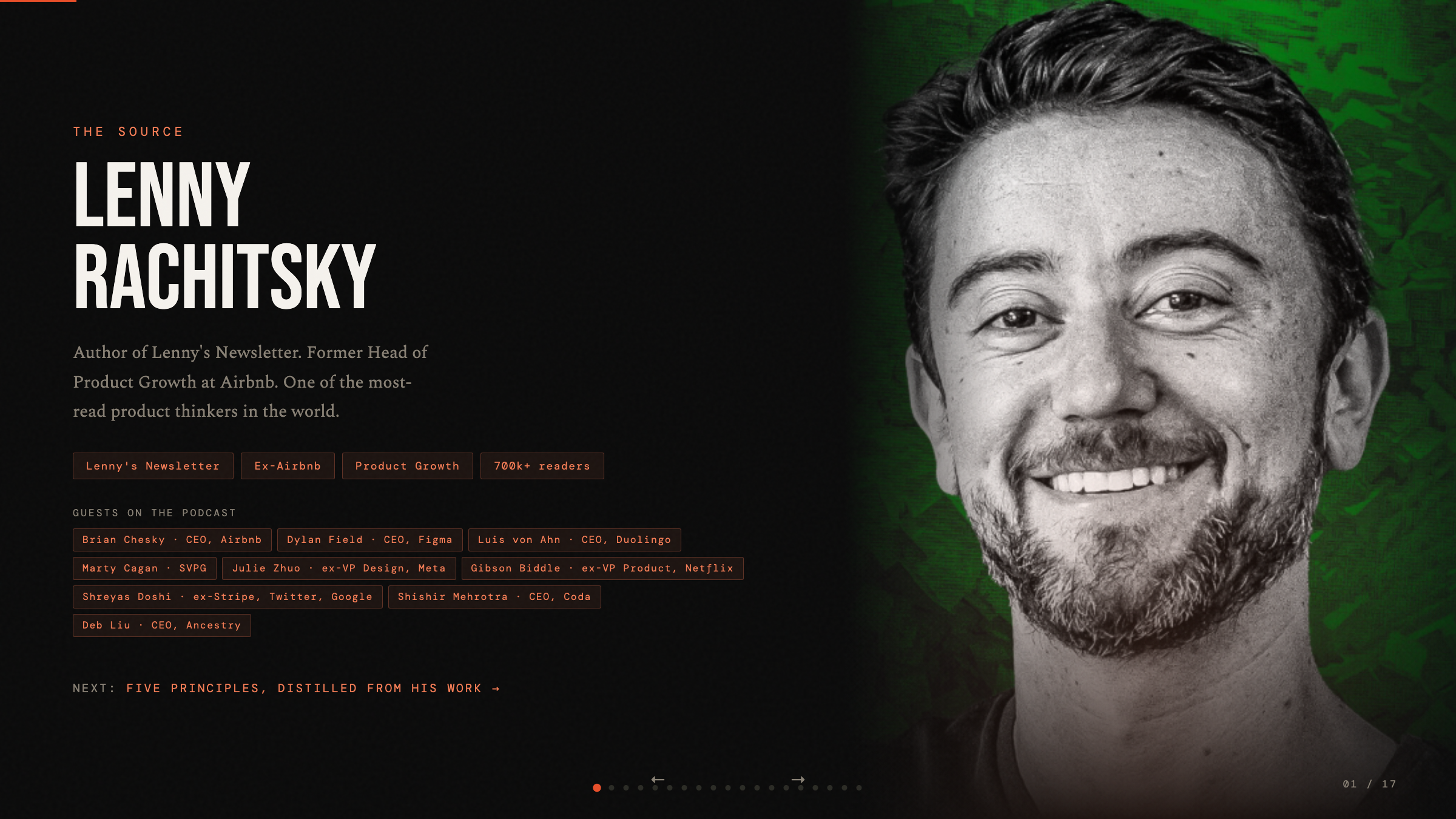
Session 3’s source slide for the 5 product principles. Lenny Rachitsky writes the most-read product newsletter in the world; we adapted his principles for supply chain practitioners building apps in Lyric Studio.
- Sara on Great Products (Session 3 guest). Sara Hoormann’s tips for building apps that get used: “Build for them, not for you.” · “Lead the horse as close to the water as you can.” · “Show, don’t tell.”
- The Hero’s Journey (Session 5, meta-pattern for Build 3). The skeleton underneath every story worth telling. Mary saves the account.
- Seven Stories Every Supply Chain Person Must Tell (Session 5, applied in Build 3). Mike Adams, adapted. Connection · Team · Origin · Insight · Proof · Stand · Teach. Students picked one and shaped their Chicago pitch around it.
- Mike & Ganesh on Storytelling (Session 5 guests). Mike Watson & Ganesh Ramkrishna’s working storytelling kit, used live in student presentations: conflict, examples, visuals, conversation, questions, keep it moving, make it you, take a chance, humanize.
Plus the tenth — the feedback framework:
- SPEC Peer Feedback. Surprising · Practical · Engaging · Confusing. Used across all three builds for peer review. Survey respondents specifically called this out as one of the most useful parts of the program.
Session 6 closed with a single recap slide that pulled the nine session-taught frameworks back together — the “toolkit” students walked into Chicago carrying:
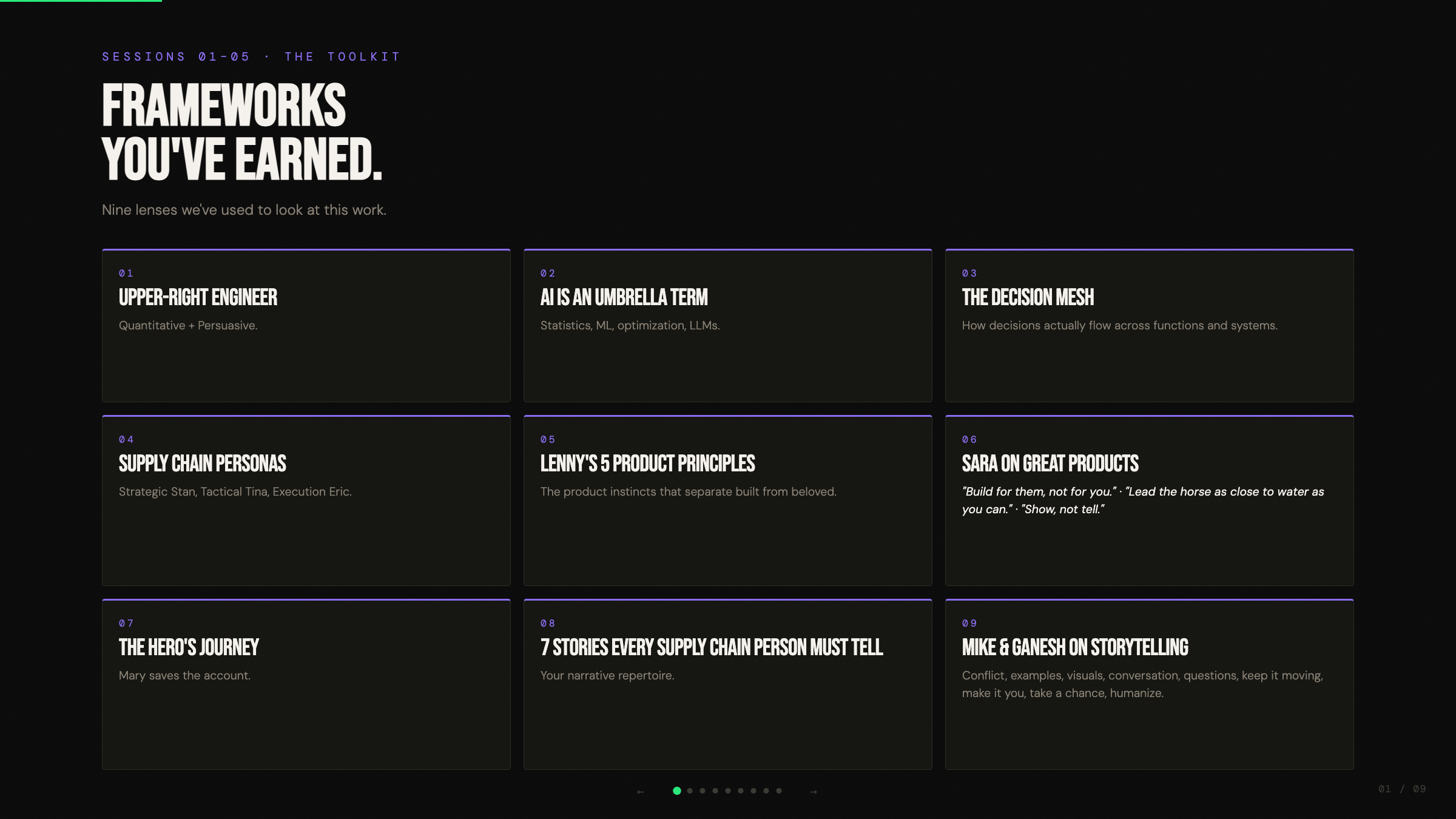
“Frameworks You’ve Earned” — the Session 6 recap. Nine named frameworks, applied across three builds, all referenceable by name. SPEC, the feedback framework, lived in every peer-review loop and isn’t on this slide.
Guest speakers
Four guest sessions shaped what students remembered most:
- Sara Hoormann (Head of Strategy & Marketing at Lyric, co-author of Supply Chain Network Modeling) — Session 3 guest on building great products. Her three tips: “Build for them, not for you,” “Lead the horse as close to the water as you can,” and “Show, don’t tell.” Andy cited “Lead the horse” as the framework that most shaped his work.
- Mike Watson & Ganesh Ramkrishna (Opex Analytics founders, decades of customer stories between them) — Session 5 guests on storytelling. Tips students named in their final presentations: Anticipate questions, Humanize it, Man in the hole, Use grayscale with colors to draw attention.
- Dinesh Natarajan — Decision Mesh & AI session.
The Finale — Chicago, May 7
One day in Chicago. The pitches ran all day inside a bank-vault venue — coffee and bagels at 9, Frank and Erin opening the room, morning pitches from 9:30 to noon, lunch, afternoon warmup and afternoon pitches from 1:45 to 3:45, then the wrap: a look at Lyric Empower (West Loop, August 11–13), certificate handouts, and the Best Storyteller crown. The vault was an unusual room — old, heavy, full of texture — and several students said the venue itself gave them something to break the ice with on arrival. Celebratory dinner moved downtown to a separate venue that evening.
Logistics rated 5/5 across every survey respondent. Multiple students named the in-person day as the single best thing about the program.
What students walked away with
- A LinkedIn-ready certificate with a deterministic credential ID (
CP-2026-XXXXXX), hosted atlyriccrescendopilot.tech/cert.html. Recipients get a stable, permanent URL they can paste into LinkedIn’s credential field. - Eight credentialed skills to add to their LinkedIn profile: Lyric Studio Prototyping, Decision Mesh Framing, Synthetic Data for Science Note Execution, Blue Note Execution & Result Interpretation, Persona-Driven Product Design (Lenny’s 5), AI-Assisted Engineering (Claude as co-builder), Executive Storytelling (Seven Stories), Cohort-Based Peer Code Review (SPEC).
- A working Lyric Studio prototype they built and presented.
- A network of peers across supply chain. Multiple students named this as the most valuable outcome.
- Continued access to prototype gym sessions post-cohort (cadence TBD).
By the numbers
Survey is partial — six students have responded as of writing. More expected by the overview meeting.
| Question | Result |
|---|---|
| Likelihood to recommend (5 of 6 scored) | 7, 8, 9, 9, 10 — avg 8.6 |
| Live session energy | 5/5 from five respondents; 4/5 from one |
| Breakout rooms | Avg 4.2/5 |
| Chicago Finale logistics | 5/5 from every respondent |
| Communications cadence | 8–10/10 |
| Hours per week on work | 5–8 for three, 8–12 for one, 12–16 for two |
| Workload | “About right” for five, “slightly too heavy” for one |
| Want to come back as moderators / panelists / students | 3 moderators, 4 guest speakers/panelists, 1 returning student |
Where the materials live
All program materials live in a private GitHub repo — session HTML decks, assignment markdown, persona examples, the certificate template, cohort photos, and the share-card generator. The repo is what powers the public-facing site at lyriccrescendopilot.tech, but the site today exposes individual session decks one at a time, not a single curated walkthrough.
A curated landing page is in progress. The goal: one URL that showcases the full program — every session, every assignment, every framework, every prototype — so a stakeholder who wasn’t in the room can see what we actually did at a glance. Until that page is live, the materials are all there in the private repo, but they’re not stitched together in a way that tells the story on its own.
Main takeaways
-
The program shipped, and it was well-received. 18 students. 18 prototypes presented in Chicago. Average peer-recommend score 8.6 / 10. Chicago Finale logistics rated 5 / 5 from every survey respondent. Workload landed at “about right” for five of six respondents.
-
The substance is a named-framework toolkit. Ten reusable frameworks — nine taught across the live sessions (Upper-Right Engineer, AI as Umbrella Term, Decision Mesh, Supply Chain Personas, Lenny’s 5, Sara on Great Products, Hero’s Journey, Seven Stories, Mike & Ganesh on Storytelling) plus SPEC as the peer-review framework used in every build. Students remembered them by name, cited them by name, and applied them in their final presentations.
-
The in-person Finale is the asset to protect. Multiple students named the Chicago day as the single best thing about the program. The combination of networking, breakout rooms, shared meals, and an on-stage pitch is what online-only competitors (MIT MicroMasters, ASCM CSCP) literally cannot offer.
-
The program is building advocates, not just graduates. Three pilot graduates want to come back as moderators for Crescendo 1. Four would return as guest speakers or panelists. One wants to repeat as a student. That’s the seed of a customer-side champion network.
-
The program exists to make students heroes inside their own companies. Breadth across the decision mesh + the storytelling craft to deliver the work = a practitioner who can earn the room. The pilot leaned more toward delivery than breadth — Crescendo 1’s curriculum will rebalance that — but the orienting goal is unchanged: every session, framework, and assignment is in service of helping students become the person their company points at when it matters.